
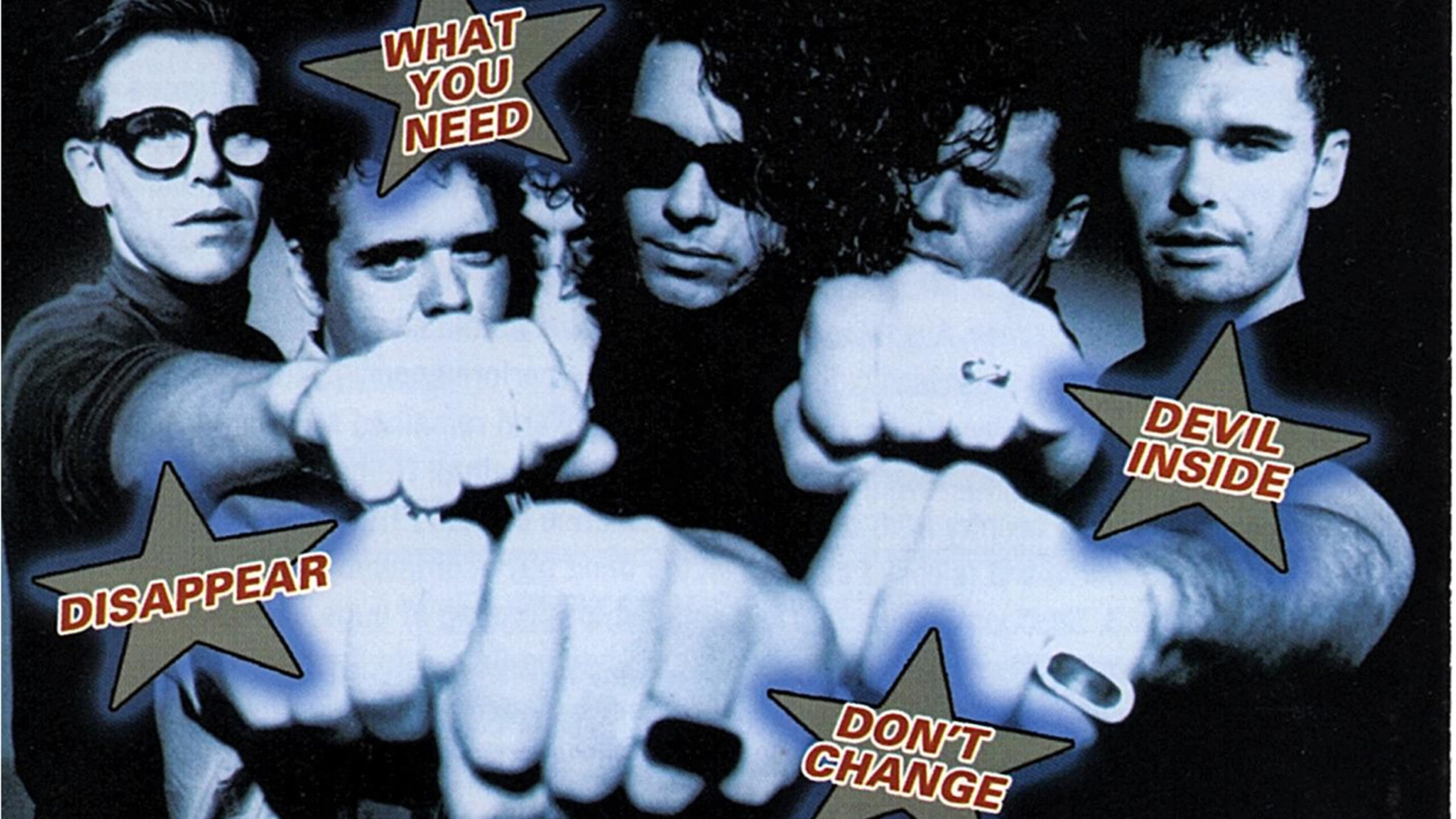
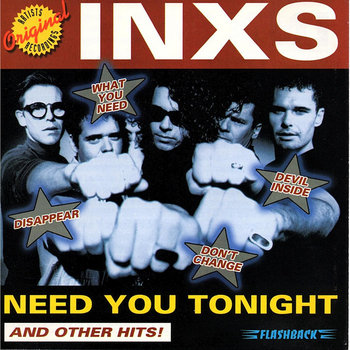
There are bands that achieve success, and then there are bands that achieve something rarer and more lasting — a sound so specific, so unmistakably their own, that it becomes impossible to hear it and think of anyone else. INXS was that second kind of band. From the time they emerged out of Sydney in the late 1970s through the decade-defining run that made them one of the biggest acts on the planet, the band from Australia built a catalog of songs that combined the intellectual restlessness of new wave, the physical urgency of funk and rhythm-and-blues, the emotional directness of rock, and something else entirely — a quality that resisted easy categorization but was instantly recognizable the moment a needle dropped or a play button was pressed. That quality had a name, and the name was Michael Hutchence.
Sunset Special Markets is proud to bring its audience Need You Tonight (And Other Hits!), a curated ten-track collection that gathers the essential INXS experience into a single listening session — one that moves from the intimate whisper of their greatest seduction to the arena-filling roar of their most anthemic moments, and everything in between. This is not a casual assembly of popular songs. It is a deliberate portrait of a band at the height of its powers, arranged to remind listeners who already love INXS exactly why they do, and to introduce anyone coming to this music fresh to one of rock history’s most fully realized artistic identities.
The Sound That Changed Everything: Understanding INXS at Their Peak. To appreciate what Need You Tonight (And Other Hits!) accomplishes, it helps to understand where INXS sat in the landscape of popular music during their commercial and artistic peak. The mid-to-late 1980s were a complicated time for rock and roll. The genre was being pulled in multiple directions simultaneously — toward the theatrical excess of hair metal on one side, toward the studied minimalism of post-punk and indie on another, toward the gleaming pop production values that were making everything louder and larger and more synthetic. Most bands made a choice between these poles and lived with the consequences.
INXS refused the choice. They developed a sound that was simultaneously hard and sleek, funky and cinematic, intimate and enormous. The rhythm section drove everything from a place of pure groove, creating foundations that were as comfortable on a dancefloor as they were in a stadium. Kirk Pengilly’s guitar and saxophone added texture and melodic intelligence without ever crowding the space. Andrew Farriss — who wrote the majority of the band’s most celebrated material, most often in collaboration with Hutchence — brought a harmonic sophistication and a producer’s ear for dynamics that prevented the band’s music from ever becoming predictable. And over all of it, Hutchence sang with a combination of charisma, vulnerability, and raw magnetism that made every performance feel genuinely urgent, like something was actually at stake.
The ten tracks gathered in this collection represent the full expression of that sound — from its most stripped and sensual to its most expansive and anthemic. They were recorded across several of the band’s most productive years and appeared on multiple albums, but they speak to each other with the coherence of a singular artistic vision because, at their core, they were always the product of the same creative intelligence.
Need You Tonight: The Most Seductive Opening in Rock History
There is an argument to be made — a strong one — that “Need You Tonight” is the most perfectly constructed seduction in the history of rock and roll. That argument begins with the guitar line: a single, arching figure played by Andrew Farriss that establishes everything the song will be in the space of two seconds. It is unhurried. It is cool. It is absolutely certain of itself. It does not ask for your attention; it simply assumes it, the way someone with genuine confidence moves through a room.
What follows is a master class in restraint and suggestion. The rhythm is loose and syncopated, all negative space and pocket groove, giving Hutchence’s voice room to breathe, to approach, to recede, to arrive closer than you expected. The lyrics are minimal almost to the point of abstraction — Hutchence and Andrew Farriss understood that seduction is not about elaboration but about implication, about leaving the listener to complete the thought — and they are delivered with a directness that bypasses the rational mind entirely and goes straight to the nervous system.
The song reached number one in the United States in early 1988, and it deserved every week it spent there. But its commercial achievement is almost beside the point. “Need You Tonight” endures because it solved a problem that most pop songs never even attempt: it made desire feel elegant. It made want feel sophisticated. It made the most basic human impulse — the need for another person — feel like something worth composing a masterpiece about.
That it opens this collection is appropriate. The song announces not just what INXS could do at their most precise and seductive, but what the entire collection intends — to demonstrate that this band was operating at a level of craft that made their commercial success feel inevitable rather than lucky.
What You Need: Funk, Confidence, and the Art of the Groove. If “Need You Tonight” is INXS at their most intimate and sleek, “What You Need” is the band at their most physically commanding. Released as the lead single from Listen Like Thieves in 1985, the song established INXS as something genuinely new in the international rock landscape — a band that had absorbed the lessons of funk and rhythm-and-blues without losing its rock identity, that could make a groove feel dangerous.
The song opens with a guitar riff that is almost percussive in its insistence, and from the moment it arrives, the entire track is in service of one thing: propulsion. The rhythm section — Jon Farriss on drums and Garry Beers on bass — locks into a pocket that is both infectious and slightly menacing, creating the kind of groove that makes it physically impossible to stay still. Andrew Farriss’s keyboard and Tim Farriss’s guitar fills weave around the central riff without obscuring it, adding color and texture while keeping the forward drive absolute.
Hutchence’s vocal performance here is among his most confident. He does not strain or reach — he simply commands, moving through the lyric with a swagger that the music fully supports. The song’s thesis — an assertion of exactly what the listener needs, delivered without a moment’s doubt — requires exactly this kind of certainty, and Hutchence delivers it with an effortlessness that disguises how difficult that quality is to manufacture.
“What You Need” was a genuine international breakthrough, reaching the top ten in multiple markets and establishing INXS as a band capable of making music that crossed every border without compromising anything essential about its identity. It remains one of the most satisfying pure rock tracks of its decade.
Dancing on the Jetty: The Forgotten Gem That True Fans Cherish
Every great band has songs that exist slightly outside the mainstream of their popularity — tracks that never achieved the commercial profile of the singles but that fans who know the catalog well tend to hold most closely. For INXS, “Dancing on the Jetty” is exactly that kind of song.
Released on The Swing in 1984, the track finds INXS at a particular transitional moment — between the post-punk energy of their earliest recordings and the fully realized international rock sound they would perfect over the following three years. The song moves differently from the tracks that surround it in this collection: it breathes, it expands, it creates space. There is something almost cinematic about the way it builds, the way Hutchence’s vocal moves between urgency and yearning, the way the instrumental arrangement frames that emotional ambiguity without resolving it prematurely.
The song’s inclusion in Need You Tonight (And Other Hits!) is a statement of artistic seriousness. A collection assembled purely for commercial recognition would not include it. But a collection assembled to give listeners a genuine understanding of what made INXS special — of the full range of their emotional and sonic vocabulary — would not omit it. “Dancing on the Jetty” reminds listeners that INXS was always more than their hits, that the catalog beneath and behind the singles was equally worth knowing.
Don’t Change: The Band Speaks as One
There is something unusual about “Don’t Change” in the INXS catalog, and it is reflected in the songwriting credit that accompanies this track in the collection. Unlike the majority of the songs here — written by Andrew Farriss and Michael Hutchence, the band’s primary creative partnership — “Don’t Change” carries a credit that includes every member of the band: Andrew Farriss, Michael Hutchence, Gary Beers, Kirk Pengilly, Tim Farriss, and Jon Farriss.
This is not merely a contractual formality. “Don’t Change” sounds like a band playing together with a unified intention that transcends the work of any two people. The song, released in 1982 on Shabooh Shoobah, is built on a riff and a groove that feel genuinely communal — an entire group of musicians listening to each other and responding in real time to what they hear. The result is one of the most emotionally direct recordings in the INXS catalog, a track that carries within it the full weight of six people who had been playing together long enough to move as a single organism.
The lyrics — an assertion of identity, a refusal to abandon who you are under the pressure of circumstance or expectation — reflect something the band clearly meant. INXS spent their entire career being told to adjust, to adapt, to sound more like whoever was currently dominant in the market. They refused, consistently, and “Don’t Change” is that refusal made into music. It is a song that sounds as certain of itself today as it did more than forty years ago, which is the only kind of certainty that actually lasts.
Disappear: The Quiet Revolution of the X Album
By the time INXS recorded X in 1990, they were one of the most successful bands on earth — the follow-up to Kick, which had become one of the best-selling albums of the 1980s, was one of the most anticipated releases of its year. The pressure that accompanied that expectation would have paralyzed most artists. INXS responded by making a record that was, in important ways, less obvious than what had come before — more textured, more interior, less immediately concerned with the dancefloor.
“Disappear” is among the finest examples of what that approach produced. The song is built on a restrained arrangement that gives Hutchence’s vocal complete emotional space — he is not competing with an insistent groove or a wall of production, but moving through a landscape of sound that has been carefully designed to allow every inflection, every change in register, every moment of vulnerability, to land with full impact. The result is a track that rewards repeated listening in a way that more immediately assertive music sometimes does not.
The song’s commercial success — it reached the top twenty in multiple markets — demonstrated that INXS’s audience was willing to follow them into more introspective territory, a testament both to the quality of the music and to the depth of the connection the band had built with their listeners over the preceding decade.
Not Enough Time: Late-Period INXS at Its Most Luminous
“Not Enough Time,” drawn from the 1992 album Welcome to Wherever You Are, represents INXS at what proved to be a late peak — a moment of musical confidence and emotional openness that produced some of the most underrated recordings of the band’s career. The album as a whole was an adventurous departure, incorporating orchestral arrangements and a broader sonic palette than the band had previously explored. “Not Enough Time” distills that ambition into something immediate and genuinely moving.
The song is, at its core, a love song — but a love song of unusual quality, one that expresses devotion not through hyperbole but through a kind of clear-eyed gratitude. The sense that time with the person you love is always insufficient, always running short, is rendered in a musical setting that itself feels luminous and slightly fleeting — something precious passing through your hands even as you try to hold it. Hutchence sings with a warmth and directness here that is deeply affecting, and the arrangement — lush but never overloaded — supports that warmth without overwhelming it.
For listeners who know INXS primarily through their early-to-mid 1980s work and their Kick-era dominance, “Not Enough Time” serves as an important reminder that the band continued to grow and expand throughout their career. The later catalog is essential listening for anyone who wants to understand what INXS truly was.
Hear That Sound: The Energy Beneath the Surface
“Hear That Sound” belongs to the tradition of INXS tracks that prioritize physical energy and rhythmic immediacy — songs designed to be felt in the body before they are understood by the mind. The track moves with the kind of insistent forward momentum that the band’s rhythm section made their signature, but it carries within that momentum a melodic and lyrical intelligence that prevents it from being merely functional.
The song’s title is itself instructive. INXS, throughout their career, asked their audience to pay attention — to the music itself, to the physical experience of listening, to the information carried by sound before language arrives. “Hear That Sound” makes that invitation explicit, positioning the act of listening as something active and engaged rather than passive and ambient. In the context of a live performance, the instruction must have felt genuinely communal — an entire arena of people directed toward the same act of attention.
Within this collection, the track provides essential energy — a reminder that INXS was always, at their foundation, a live band, a group of musicians who had built their identity in the heat and pressure of performance, who understood that great recorded music should carry within it some trace of that live urgency.
Devil Inside: The Darkness at the Heart of the Groove
Of all the tracks gathered in Need You Tonight (And Other Hits!), “Devil Inside” is perhaps the most morally complex — the one that most clearly demonstrates the range of INXS’s emotional and thematic intelligence. The song, released on Kick in 1987 and a major international hit in 1988, inhabits a territory that most pop music declines to enter: the space where desire, compulsion, and self-knowledge intersect uncomfortably.
The lyric — an examination of the impulses that pull human beings toward behavior they might not endorse in the light of day — is delivered over one of the most irresistible grooves of its era. The tension between the darkness of the subject matter and the sheer physical pleasure of the music is not accidental; it is the point. INXS understood that the most honest way to write about temptation is to make the song itself tempting, to put the listener in the position of being seduced by something they might, in a different context, resist.
The production on “Devil Inside” is immaculate — every element placed with precision, the dynamic shifts carefully managed to keep the track building over its entire length without ever releasing the tension fully. It is, by any measure, one of the great productions of its decade, and it is one of the tracks that most clearly demonstrates why Kick became the phenomenon it was.
All Around: The Breadth of the Band’s Vision
“All Around” represents another dimension of the INXS catalog — a track that opens outward rather than inward, that reaches for something expansive and inclusive rather than intimate and focused. The song exemplifies the band’s ability to shift emotional and sonic register without losing the thread of their identity — to move from the close quarters of seduction to the wide-angle perspective of something more universal without the transition feeling forced or inconsistent.
Within this collection, “All Around” serves an important structural function: it reminds listeners that the INXS catalog is larger and more varied than any single defining image of the band — that the band who made the most seductive opening track of their era also made music that aspired to something genuinely communal and wide-reaching. That breadth is part of what made INXS more than a singles band, more than a cultural moment. It is what made them a body of work.
Good Times: When Australia’s Finest Shared a Stage
The collection closes with something genuinely special — a collaboration that brought together two of Australia’s most celebrated musical identities for a performance that captures the full, unrestrained exuberance of rock and roll at its most celebratory. “Good Times,” performed by INXS with Jimmy Barnes, was originally recorded for the 1986 film Dogs in Space, a project that brought together several key figures of the Australian music scene at a particular moment of creative ferment.
The song itself is a cover of a track originally recorded by the Easybeats in 1966 — written by George Young and Harry Vanda, two names that occupy a foundational position in Australian rock history. That the song passed from the Easybeats to INXS and Jimmy Barnes is itself a kind of lineage story, a demonstration of how musical energy travels between generations within a creative tradition.
Jimmy Barnes was, by the mid-1980s, one of the most distinctive voices in Australian rock — raw, physically overwhelming, a vocalist who approached every performance as if something essential was at stake. His presence alongside Hutchence creates a collision of two entirely different vocal personalities: Hutchence’s cool, gliding sensuality against Barnes’s incandescent urgency. The result is electric in the specific way that can only happen when two genuinely great performers with genuinely different approaches find themselves in the same room, pointed in the same direction.
“Good Times” closes this collection on a note of pure, unambiguous joy — a reminder that before INXS was a cultural phenomenon, before they were the subjects of documentaries and retrospectives and anniversary editions, they were a band of musicians who loved playing music, who understood that the point of all the sophistication and craft was, ultimately, to make people feel something good. The song achieves that completely, which is why it remains, decades after its recording, as irresistible as the moment it was made.
The Legacy of INXS: Why This Music Still Matters
In the years since Michael Hutchence’s death in November 1997, the INXS catalog has continued to grow in cultural significance in ways that could not have been predicted at the time. The band’s music has appeared in films, television series, advertising campaigns, and streaming playlists with a frequency that speaks to its genuine timelessness — its capacity to function across contexts, to speak to new listeners who were not alive when the recordings were made, to feel not like nostalgia but like discovery.
This is the mark of music that was genuinely great rather than merely popular. Popular music from any given era often sounds, in retrospect, like a document of that era’s production fashions and cultural preoccupations — interesting as history but difficult to encounter as pure sound. The best INXS recordings do not have this problem. They sound like themselves, which is to say they sound like something that cannot be placed or dated or categorized without remainder — something that exceeds the categories applied to it.
The songwriting partnership between Andrew Farriss and Michael Hutchence is, in retrospect, one of the great unacknowledged creative collaborations in rock history. Farriss’s musical intelligence — his harmonic sensibility, his production instincts, his ability to build arrangements that were simultaneously complex and immediately accessible — met Hutchence’s lyrical intuition and vocal presence in a combination that produced song after song that felt inevitable, like it could not have been written any other way. The ten tracks gathered in Need You Tonight (And Other Hits!) are the most compelling possible evidence for that assessment.
A Listening Experience Designed for Discovery and Return
What Sunset Special Markets has assembled in Need You Tonight (And Other Hits!) is something that functions simultaneously as an entry point and as a reward for long familiarity. For the listener encountering INXS seriously for the first time — perhaps through the renewed interest generated by the band’s continuing presence in streaming culture, perhaps through the influence of younger artists who have cited INXS as foundational — this collection offers the most efficient possible route to understanding why this band mattered. Ten tracks, across ten distinct emotional and sonic registers, spanning the full arc of the band’s creative development, each one representing a different facet of a singular and irreplaceable artistic identity.
For the listener who has loved this music for decades, the collection offers the particular pleasure of reunion — the experience of hearing something deeply familiar with fresh ears, of being reminded why these songs were always worth the devotion they inspired. Great music has this quality: it is never entirely the same record twice, because the person listening to it is never entirely the same person. The INXS catalog has sustained this quality across multiple generations of listeners, and it will continue to do so.
The band’s history, their influence, their tragedy, and their endurance are all present in these ten tracks — not as explicit narrative, but as the emotional residue of music made by people who were fully present in the act of creating it. That presence is what you hear when you press play. It is what makes this music impossible to dismiss, impossible to outgrow, impossible to forget.
Need You Tonight (And Other Hits!) is available now through Sunset Special Markets and distributed across all major digital platforms.
Track by Track at a Glance – Click here to download!
Need You Tonight — Andrew Farriss & Michael Hutchence — The defining INXS moment: lean, irresistible, and unlike anything else in its era.
What You Need — Andrew Farriss & Michael Hutchence — Funk-driven and physically commanding, the track that broke the band internationally.
Dancing on the Jetty — Andrew Farriss & Michael Hutchence — The catalog gem that rewards patient listeners and reveals the band’s full emotional range.
Don’t Change — Andrew Farriss, Michael Hutchence, Gary Beers, Kirk Pengilly, Tim Farriss & Jon Farriss — A full-band statement of identity that sounds as certain today as it did four decades ago.
Disappear — Andrew Farriss & Michael Hutchence — X-era INXS at their most interior and emotionally spacious.
Not Enough Time — Andrew Farriss & Michael Hutchence — Late-period luminosity from an underappreciated chapter of the band’s career.
Hear That Sound — Andrew Farriss & Michael Hutchence — Physical energy and melodic intelligence in perfect balance.
Devil Inside — Andrew Farriss & Michael Hutchence — The moral complexity and production mastery that made Kick a landmark.
All Around — Andrew Farriss & Michael Hutchence — Expansive and inclusive, the wide-angle view of the INXS vision.
Good Times — George Young & Harry Vanda — INXS with Jimmy Barnes, closing the collection in a blaze of pure, uncontained joy.